
By | Medically Reviewed by Christopher W. Boelter, MD | Last updated 2026-07-14
When a Urinary Infection Comes Back, the Important Question Is Why
A man develops burning with urination and needs to go every hour. He receives an antibiotic and feels better. A few weeks later, the same symptoms return. It is tempting to regard this as bad luck and repeat the prescription. Sometimes another infection really has occurred. In other cases, bacteria were never fully cleared from the prostate, urine remains trapped behind an obstruction, or a stone or foreign body gives bacteria a place to persist.
A second antibiotic may treat the next episode, but it will not correct a stone, obstruction, retained urine, or another condition that allows infection to return. This is why recurrent urinary tract infections in men deserve a broader assessment than a single, uncomplicated episode. The goal is not to make the evaluation alarming. It is to identify what is maintaining the problem before repeated treatment obscures the pattern or encourages antimicrobial resistance.
At Adult and Pediatric Urology, we begin by separating three questions that patients often hear as one: Was this truly a bacterial infection? Is this the same infection returning or a new infection? Is there a problem in the urinary tract that makes recurrence more likely? The answers come from the symptom history, examination, properly collected urine tests and selective urologic testing.
Urinary frequency, urgency and pain are not diagnoses by themselves. They can occur with infection, a ureteral stone, bladder irritation, urethral inflammation, prostate inflammation, incomplete emptying and several noninfectious pelvic pain conditions. Men whose cultures remain negative may need a different diagnostic path, including evaluation for chronic pelvic pain syndrome in men, rather than repeated courses of antibiotics.
What Doctors Mean by a Recurrent Urinary Tract Infection
The word recurrent is used when separate symptomatic infections occur after an earlier episode has been treated. A useful clinical distinction is whether the episode appears to be a relapse or a reinfection. That distinction cannot be made reliably from symptoms alone.
Relapse: the Earlier Infection May Have Persisted
A relapse is suspected when symptoms return soon after treatment and the culture identifies the same organism, especially with a similar susceptibility pattern. The timing is informative, but it is not sufficient by itself. A clinician also considers whether the antibiotic reached the relevant tissue, whether it was active against the organism and whether an infected focus remains.
In men, the prostate matters. Bacteria can persist in prostatic tissue and later reseed the urine. Repeated growth of the same organism, pelvic or perineal discomfort, painful ejaculation or a history of febrile infection may raise concern for bacterial prostatitis. Acute bacterial prostatitis and chronic bacterial prostatitis are different clinical conditions, so the examination, urgency and treatment approach are not interchangeable.
Reinfection: a New Episode After the Earlier One Cleared
Reinfection means a later infection is caused by a different organism or follows documented clearance of the earlier episode. Even when each episode is new, recurrence can still point to a common enabling factor. A bladder that does not empty well, for example, leaves a residual pool of urine in which bacteria can multiply.
This is where the question why urinary tract infections keep coming back in men becomes more useful than counting antibiotic courses. The pattern of organisms, the interval between episodes and the symptoms between infections can direct the urologist toward the prostate, bladder outlet, upper urinary tract or a noninfectious explanation.
Urine Culture Is the Starting Point, Not a Formality
A recurrent infection should be documented with culture whenever practical before antibiotics, because symptoms alone cannot identify the organism or prove that bacteria are the cause. A urine culture shows whether clinically significant bacterial growth is present. Susceptibility testing then helps the clinician choose an antibiotic that is likely to work against that specific organism.
A dipstick or urinalysis can support the diagnosis by showing findings such as white blood cells, nitrite or blood, but it does not replace culture in a man with recurrent symptoms. The sample should be collected correctly, ideally before the first antibiotic dose. If the patient is acutely ill, treatment should not be dangerously delayed merely to create a perfect specimen. The treating clinician balances prompt care with obtaining useful cultures.
Culture results must be read in context. Bacteria in urine without urinary or systemic symptoms do not automatically require antibiotics. Conversely, a negative culture obtained after antibiotics may be less informative. The urologist reviews when the sample was taken, how it was collected, which organism grew and whether the result fits the clinical picture.
- Bring copies of earlier urine cultures, not only the names of antibiotics.
- Record when symptoms began in relation to each treatment course.
- Tell the clinician about fever, chills, flank pain, pelvic pain or difficulty emptying.
- List prior stones, urinary procedures, catheters and prostate diagnoses.
- Report antibiotic allergies and any previous resistant organisms.
The Conditions That Can Keep an Infection Going
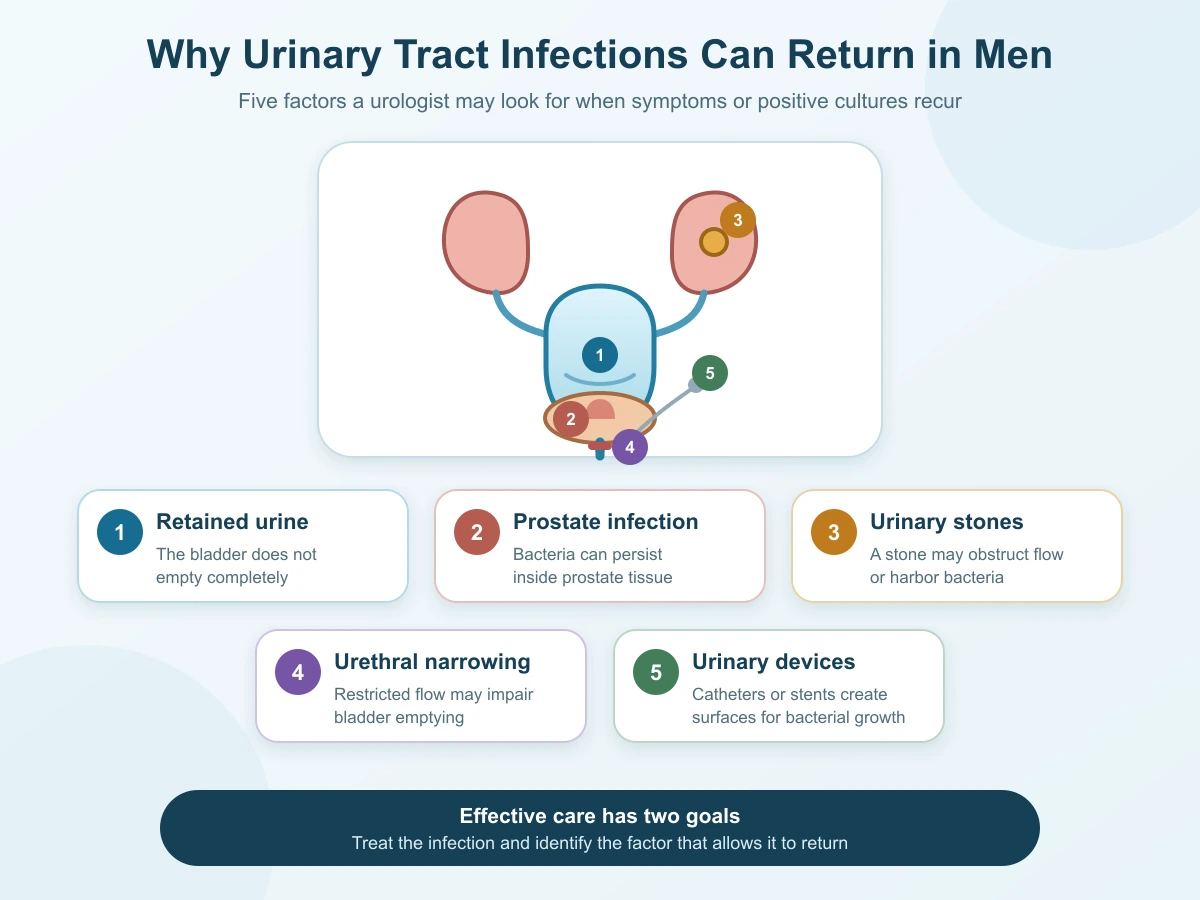
A urinary tract infection is not always an isolated event. Urine needs to flow from the kidneys, through the ureters, into the bladder and out through the urethra. Any condition that blocks that route, leaves substantial residual urine or introduces a foreign surface can change the risk of infection.
Incomplete Emptying and Prostate Enlargement
Benign prostate enlargement can narrow the bladder outlet. The bladder may compensate for a time by contracting harder, but some men eventually retain urine after voiding. That does not mean every enlarged prostate causes infection. It means that incomplete bladder emptying is one of the factors worth measuring when infections recur alongside a weak stream, hesitancy, straining or a feeling that the bladder is still full.
The broader symptom pattern is explained in our guide to male urinary symptoms and their evaluation. A post-void residual measurement can show how much urine remains after urination, but the number is interpreted with the history rather than treated as a diagnosis on its own.
Stones, Narrowing and Foreign Bodies
Kidney or urinary tract stones may obstruct drainage or harbor bacteria. Infection combined with an obstructed kidney is an emergency because antibiotics cannot provide source control if infected urine cannot drain. Men with sudden flank pain, vomiting or blood in the urine can review the warning signs in our kidney stone guide for men.
A urethral stricture can also slow the stream and impair emptying. Prior instrumentation, urethral injury or inflammation may be relevant. Persistent spraying, straining or a progressively weak stream may justify evaluation for urethral stricture. Catheters, ureteral stents and other urinary devices create additional surfaces on which bacteria can form communities, so device necessity and timing may need review.
Prostate Infection and Urinary Tract Abnormalities
The prostate can act as a bacterial reservoir. A history of recurrent cultures growing the same organism is particularly important. Structural or functional abnormalities of the kidneys, ureters or bladder may also interfere with drainage. Some have been present since birth; others develop after surgery, neurologic disease or years of obstruction.
Diabetes, immune suppression and impaired kidney function can affect infection risk and clinical decisions, but they do not eliminate the need to look for a correctable urinary cause. The workup is individualized because the same label can describe very different patients.
Symptoms, Possible Explanations and the Tests That May Help
No single test is required for every patient. This table shows how a clinical clue may lead to a focused question. It is not a self-diagnosis chart, and several conditions can produce the same symptom.
| Clinical clue | What it may suggest | Possible next step |
|---|---|---|
| Weak stream, hesitancy or incomplete emptying | Bladder outlet obstruction, prostate enlargement or urethral narrowing | Flow assessment, post-void residual and focused examination |
| Repeated culture with the same organism | Persistent focus, prostate involvement, stone or foreign body | Culture review, prostate assessment and selective imaging |
| Flank pain, fever or chills | Systemic infection, kidney involvement or obstruction | Urgent examination, laboratory tests and imaging when indicated |
| Pelvic or perineal pain | Prostatitis or a noninfectious pelvic pain condition | Focused history, examination and properly timed urine testing |
| Blood that persists after infection treatment | Stone, inflammation or another urinary tract condition | Repeat urinalysis and risk-based hematuria evaluation |
| Prior catheter, stent or urinary surgery | Device-associated infection or structural change | Device review and targeted urologic assessment |
When Urinary Symptoms Are Not Caused by Bacteria
Burning, urgency and pelvic pressure can be very convincing, yet they do not always come from a bacterial infection. Urethritis, a sexually transmitted infection, a passing stone, bladder pain syndrome, medication effects, pelvic floor dysfunction and chronic pelvic pain can overlap with familiar male UTI symptoms.
This matters because an antibiotic can coincide with natural improvement and create the impression that infection was proven. If repeated cultures collected before treatment show no bacterial growth, the diagnostic plan should widen. The clinician may ask about urethral discharge, sexual exposure, pain after ejaculation, bladder filling, bowel symptoms and whether discomfort continues when urinalysis is normal.
Visible blood in the urine, or microscopic blood that remains after an infection has resolved, should not automatically be attributed to cystitis. It may require a separate risk-based evaluation. Recurrent symptoms should make the diagnosis more precise, not merely make the antibiotic stronger.
How a Urologist Chooses the Evaluation
The aim is not to order every urologic test for every man. It is to select the tests that answer the clinical question raised by his pattern of recurrence. The appropriate tests for recurrent urinary tract infections in men depend on age, symptom severity, culture history, urinary flow, prior procedures and signs of upper tract disease.
History, Examination and Bladder Emptying
The consultation usually begins with a timeline. Culture reports are compared organism by organism. A medication review can reveal drugs that impair emptying. The examination may include the abdomen, external urinary opening and, when clinically appropriate, the prostate. Urinalysis and culture are obtained according to the current presentation.
Bladder ultrasound after voiding can estimate residual urine. Uroflowmetry may help characterize a weak stream. Men who cannot pass urine, especially with lower abdominal pain, need urgent care rather than a routine appointment. Our explanation of acute urinary retention describes why prompt bladder drainage may be necessary.
Imaging
Imaging is used when the clinician needs to look for urinary obstruction, hydronephrosis, stones, an abscess or another structural problem. Ultrasound may be an appropriate first study in many settings. Computed tomography provides different detail and is often considered when a stone or complication is suspected, symptoms are severe, the patient deteriorates, or fever persists despite appropriate treatment.
Routine imaging of every mild lower urinary episode would expose some patients to cost and, with certain studies, radiation without answering a useful question. On the other hand, systemic illness or suspected obstruction changes the threshold quickly.
Cystoscopy
Cystoscopy allows a urologist to inspect the urethra and bladder with a small camera. It is not automatically required simply because two infections occurred. It may be appropriate when there is concern about urethral narrowing, bladder pathology, a foreign body, persistent hematuria or another lower urinary tract abnormality that cannot be resolved by less invasive tests.
Treatment Has Two Parts: Control the Infection and Address the Cause
The immediate task is to treat a confirmed infection safely. Antibiotic selection should reflect the culture when available, prior resistance, allergies, kidney function, illness severity and whether the prostate or kidneys may be involved. A drug that is reasonable for a localized bladder infection may not be appropriate for prostate or kidney infection.
The second task is source control. Depending on the findings, that may mean relieving obstruction, draining an infected blocked system, managing a stone, reviewing a catheter or stent, treating prostate infection appropriately, or correcting a clinically important emptying problem. This is the central principle behind treatment for recurrent urinary tract infections in men: eradicate bacteria and remove the reason they are able to persist when that reason is modifiable.
Patients should not keep leftover antibiotics for the next episode or change the dose based on symptoms. That can suppress bacterial growth before culture, expose the patient to adverse effects and select for resistance. It may also delay recognition of a stone, retention or systemic infection.
A Composite Clinical Example
The following example is a composite created for education and does not describe a specific APUMN patient. A man reports three episodes of burning and urgency. The first was treated without culture. During the second, culture grew a urinary pathogen and symptoms improved. During the third, the same organism was found, and he also described a progressively weaker stream and a persistent sense of incomplete emptying.
The important finding is not simply that he has had three prescriptions. The repeated organism raises the possibility of persistence, while the change in stream raises a separate question about outlet obstruction. A focused evaluation might therefore include review of both cultures, examination, a post-void residual and testing selected from the results. If substantial retained urine or another correctable cause is found, treating that cause becomes part of infection prevention.
Warning Signs That Need Prompt or Emergency Care
A lower urinary infection can progress beyond the bladder. Fever, shaking chills, flank or back pain, vomiting, confusion, marked weakness, rapid breathing or a generally toxic appearance can indicate systemic infection. Inability to urinate, severe lower abdominal pain or a suspected infected obstructed kidney also requires urgent assessment.
The practical answer to when a urinary tract infection needs urgent care is when the patient is systemically unwell, cannot keep fluids or medication down, cannot urinate, has severe pain, or is worsening despite treatment. Sepsis can develop rapidly. An obstruction combined with infection may require drainage in addition to intravenous antibiotics and supportive care.
- Fever or shaking chills with urinary symptoms
- Flank pain, repeated vomiting or inability to drink
- Confusion, faintness, breathing difficulty or profound weakness
- Complete inability to pass urine
- Worsening symptoms after treatment has begun
What to Bring to a Urology Appointment
A good record can prevent the evaluation from starting over. Bring the laboratory reports from each episode, including the organism and susceptibility panel. A pharmacy list is helpful, but it cannot replace the cultures. Note whether symptoms disappeared completely between episodes and whether fever, pelvic pain, flank pain or a change in urinary stream occurred.
Also mention stones, prostate treatment, urinary surgery, catheterization, neurologic disease, diabetes and any earlier imaging. This information helps the urologist distinguish an isolated recurrence from a pattern requiring structural or functional investigation.
Medical Disclaimer
This article provides general education and is not a diagnosis or a personal treatment plan. Urinary symptoms, antibiotic choice and the need for imaging or procedures require individual medical assessment. Seek urgent care for fever with severe illness, flank pain, confusion, vomiting, inability to urinate or rapidly worsening symptoms.
Frequently Asked Questions
Why Are Urinary Tract Infections Less Common but More Concerning in Men?
The male urethra is longer, which reduces the likelihood of bacteria reaching the bladder. When infections recur, clinicians are therefore more likely to consider prostate involvement, impaired emptying, stones, narrowing, devices or another urinary tract factor. Recurrence does not prove that a serious abnormality is present, but it supports specialist assessment.
Should Every Suspected Infection Be Confirmed With a Urine Culture?
For a man with recurrent symptoms, culture before antibiotics is highly valuable whenever the clinical situation permits. It confirms bacterial growth, identifies the organism and guides treatment. Emergency treatment should not be delayed in a severely ill patient, but cultures should be collected promptly when possible.
Can an Enlarged Prostate Cause Recurrent Urinary Tract Infections?
An enlarged prostate can narrow the bladder outlet and contribute to retained urine, which may increase infection risk. Prostate size alone does not establish the cause. Symptoms, urinary flow and the amount left after voiding help determine whether obstruction is clinically important.
What Tests May a Urologist Order?
Testing may include urinalysis, urine culture, assessment of residual urine, urinary flow testing, ultrasound or other imaging. Cystoscopy is reserved for selected questions such as suspected narrowing, persistent blood, a foreign body or bladder pathology. Not every patient needs every test.
Which Symptoms Require Urgent Care?
Seek prompt care for fever, chills, flank pain, vomiting, confusion, severe weakness, inability to urinate or worsening despite treatment. Infection plus urinary obstruction can become an emergency and may require drainage as well as antibiotics.