
By | Medically Reviewed by Christopher W. Boelter, MD | Last updated 2026-07-15
The Short Answer: Improvement Is Usually a Trend, Not a Switch
Men often ask how long does Flomax take to work because urinary symptoms interfere with sleep, travel, work, and confidence. Tamsulosin, sold under the brand name Flomax, begins acting on alpha-1 receptors after a dose, but the moment the medicine enters the body is not the same as the moment a patient notices meaningful relief. Some men report a change in urine flow or less hesitation during the first several days. Others need a few weeks to decide whether the improvement is real. Some notice little benefit because the main cause of their symptoms is not the type of outlet resistance that tamsulosin can relieve.
The first six weeks are best treated as an observation period with safety checkpoints. Look for a pattern across several days rather than judging the medicine after one trip to the bathroom. A stronger stream may appear before nighttime urination changes. Straining may decrease while urgency remains. A difficult night after extra fluid, alcohol, poor sleep, or a missed dose does not necessarily mean the medicine has failed.
Do not increase, stop, restart, or combine tamsulosin with another urinary medicine on your own because the response seems slow. The prescribing clinician needs to consider the dose, timing, blood pressure, other medications, side effects, and whether the original diagnosis still fits. The approved labeling allows a clinician to consider a higher dose after an inadequate response to the usual dose, but that is a prescribing decision, not a home experiment.
In this practical guide, Jerome P. Keating, MD, explains what to expect during the first six weeks of tamsulosin. It is a timeline for observation, not a promise that every symptom will improve on the same day. If you cannot pass urine, have fever with painful urinary symptoms, see blood in the urine, or develop severe lower abdominal pain, skip the timeline and seek prompt medical care.
What Tamsulosin Changes and What It Does Not
Tamsulosin is an alpha-1 adrenergic blocker used for signs and symptoms of benign prostatic hyperplasia (BPH). It reduces smooth-muscle tone in the prostate and bladder neck. When that muscle tone contributes to resistance at the bladder outlet, relaxation can make it easier for urine to pass.
Tamsulosin can improve the passage of urine by relaxing muscle, but it does not shrink prostate tissue and it does not cure every cause of urinary symptoms. That difference matters when discussing Flomax for enlarged prostate. A drug that relaxes muscle can act sooner than a medicine intended to reduce prostate volume, yet even a pharmacologic effect that begins promptly may take time to become noticeable in daily life.
The medicine may help weak stream, hesitancy, intermittent flow, straining, and the sensation of incomplete emptying when outlet resistance is an important part of the problem. Storage symptoms, including urgency, frequency, and nocturia, may improve less predictably because they can also arise from bladder overactivity, excess urine production, sleep disruption, infection, diabetes, diuretic use, or incomplete emptying.
For a broader explanation of symptoms that can occur with prostate and bladder conditions, see the APUMN guide to male urinary symptoms. The purpose of treatment is not simply to make a number lower. It is to reduce the symptoms that bother the patient while protecting bladder and kidney function and avoiding unacceptable adverse effects.
A Six-Week Timeline for Benefit and Safety
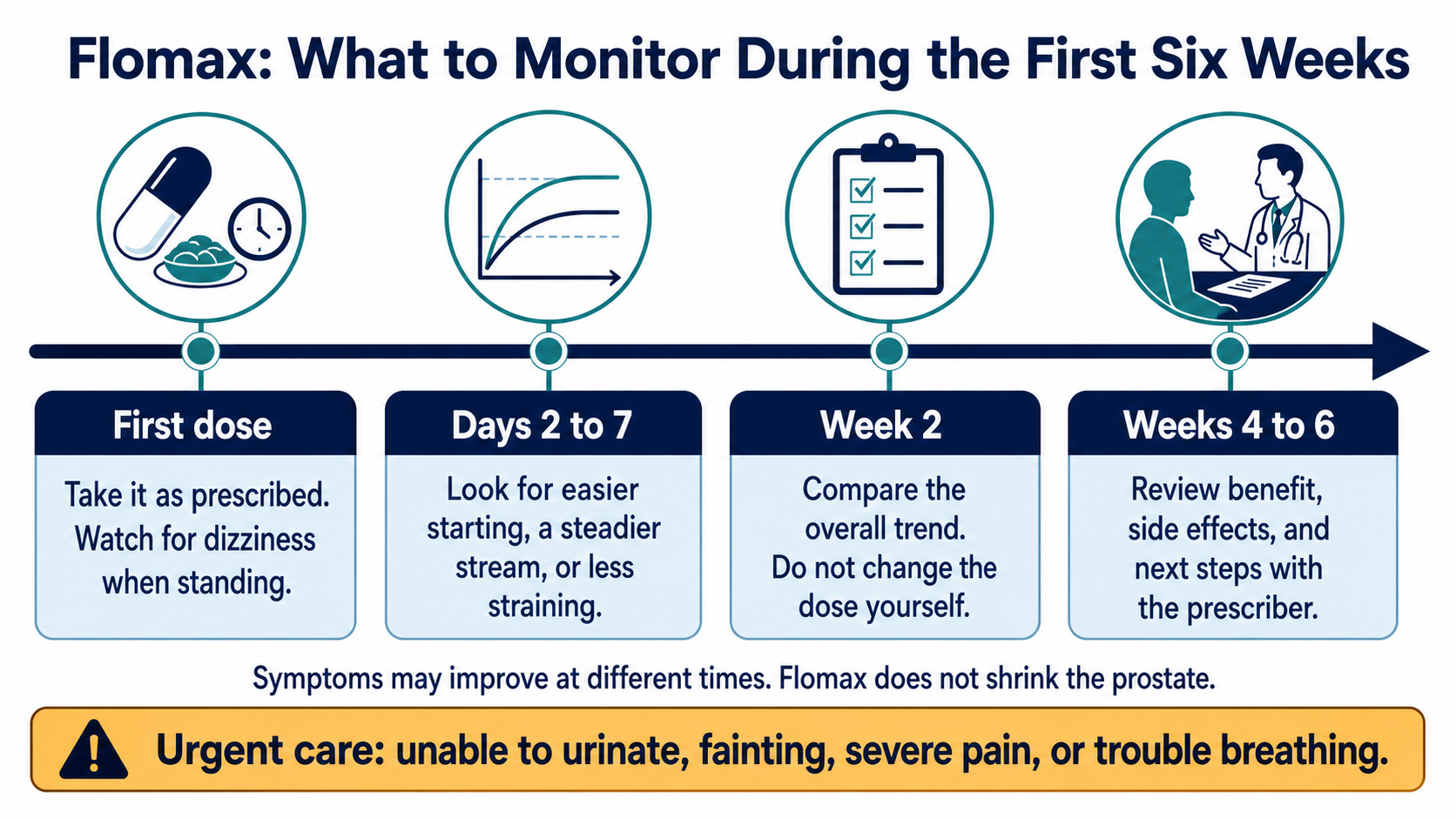
The following checkpoints describe what may be reasonable to observe. They do not set a deadline for success. The tamsulosin onset of action and the patient’s perceived response are related but not identical, so a short written record is more useful than trying to remember whether last Tuesday felt better than today.
After the First Dose
Take tamsulosin exactly as prescribed, usually about 30 minutes after the same meal each day. Swallow the capsule whole. Consistent timing helps maintain predictable exposure and makes it easier to connect symptoms or adverse effects with the medicine.
The main early safety issue is dizziness, lightheadedness, or faintness, particularly when standing up. This can occur because alpha blockade may lower blood pressure in some people. Rise slowly from bed or a chair, pause before walking, and use extra care on stairs. Until you know how the medicine affects you, avoid driving or hazardous work if you feel dizzy or drowsy.
Days 2 Through 7
During the first week, look for direction rather than perfection. Urination may start with less waiting, the stream may feel less restricted, or less abdominal effort may be needed. These changes can be subtle. Frequency and nighttime trips may not move in parallel, especially when bladder storage, evening fluids, sleep, or other medical conditions contribute.
Do not test the medicine by deliberately holding urine, drinking excessive water, or changing the prescribed schedule. Note any dizziness, nasal congestion, unusual fatigue, or ejaculation change. If faintness is severe, persistent, or associated with a fall, contact the prescribing office rather than waiting for the next routine visit.
At Two Weeks
By two weeks, many patients can make a more reliable comparison with their baseline. Ask practical questions: Is it easier to start? Is the stream less interrupted? Is less straining required? Does the bladder feel emptier? Are nighttime awakenings actually fewer, or is falling back asleep easier even if the number is unchanged?
A total lack of benefit at two weeks is a reason to check adherence, meal timing, missed doses, side effects, and the working diagnosis. It is not a reason to take an extra capsule. The article on Flomax interactions explains why the rest of the medication list matters when a clinician reviews safety.
At Four Weeks
Four weeks is a useful checkpoint for a medication with a relatively short onset compared with prostate-shrinking therapy. A clinician may compare the current symptom pattern with the baseline, review adverse effects, and decide whether the response is adequate. The International Prostate Symptom Score can structure that comparison, but it does not identify the cause of the symptoms by itself.
If the stream remains weak or symptoms are still bothersome, the next step may be a medication review, examination, urinalysis, post-void residual measurement, uroflowmetry, or another targeted test. The appropriate choice depends on the history. Simply switching or escalating treatment without reassessing the cause can delay the right diagnosis.
Weeks 4 Through 6
At this stage, the question is not whether every bathroom trip is normal. The question is whether there is a consistent, worthwhile improvement with tolerable side effects. A patient who is clearly better may continue the plan under the prescriber’s direction. A patient who is unchanged, worse, or troubled by adverse effects needs a review of the diagnosis and options.
A six-week review is especially important when there is persistent incomplete emptying, recurrent infection, blood in the urine, pain, worsening urgency, or a history of urinary tract procedures. This is the point at which why Flomax is not improving urine flow becomes a diagnostic question rather than merely a medication question.
Which Symptoms May Change First?
Urinary symptoms do not form one single package. Emptying symptoms and storage symptoms can have different causes, so they may respond at different speeds. The table below is a monitoring guide, not a forecast.
| Symptom | What improvement may look like | Why it may persist |
|---|---|---|
| Weak stream | A stream that feels less restricted or stops less often | Fixed narrowing, large obstructing anatomy, or weak bladder contraction |
| Hesitancy and straining | Less waiting and less effort to begin or maintain urination | Outlet obstruction, urethral narrowing, pelvic floor dysfunction, or bladder weakness |
| Incomplete emptying sensation | Less pressure or less need to return soon after voiding | Residual urine, altered bladder sensation, or impaired bladder contraction |
| Urgency and frequency | More time between trips and fewer sudden urges | Overactive bladder, infection, high fluid intake, diabetes, or bladder irritation |
| Nocturia | Fewer awakenings or a longer first sleep interval | Nighttime urine production, sleep apnea, edema, diabetes, medication timing, or reduced bladder capacity |
Men often focus on nighttime urination because it is exhausting, but nocturia is one of the least specific urinary complaints. The APUMN article on causes of nocturia in men explains why treating the prostate alone may not stop nighttime awakenings.
How to Track Whether Flomax Is Helping
A useful record should be brief enough to maintain. For how to track urinary symptoms after starting tamsulosin, choose two or three complaints that matter most and record them at baseline, then again at the end of weeks one, two, four, and six. Use the same wording each time.
- Number of nighttime bathroom trips
- Difficulty starting the stream
- Need to strain
- Frequency of interrupted flow
- Urgency or leakage episodes
- Feeling of incomplete emptying
- Dizziness, faintness, falls, or ejaculation changes
Include missed doses and any major change in evening fluids, alcohol, caffeine, cold medicines, or diuretics. A short record helps the clinician distinguish a real medication response from normal day-to-day variation. It also gives the visit a patient-centered focus: the most important change may be sleeping four uninterrupted hours, leaving home without mapping every restroom, or urinating without prolonged straining.
Dizziness and Standing Up Safely
Among the best-known tamsulosin side effects are dizziness, lightheadedness, and symptoms related to a fall in blood pressure when standing. Risk deserves particular attention after treatment begins, after a clinician increases the dose, or after treatment has been interrupted and restarted.
- Sit at the edge of the bed for a moment before standing.
- Stand near a stable surface until you know you are steady.
- Avoid driving or operating machinery when dizzy or unusually drowsy.
- Tell the prescriber about falls, fainting, or persistent lightheadedness.
- Do not compensate by changing the dose or schedule without instructions.
Blood pressure medicines, other alpha blockers, medicines for Erectile dysfunction (ED), and several drugs that affect tamsulosin metabolism can change the safety picture. This does not mean every combination is prohibited. It means the clinician and pharmacist need the complete list, including prescriptions, over-the-counter products, vitamins, and supplements.
Ejaculation Changes: Important, Usually Not an Emergency
Tamsulosin can reduce the amount of semen released, cause an ejaculation with little or no visible semen, or otherwise change ejaculation. Patients may call this retrograde ejaculation, but the physiology with selective alpha blockers can be more complex than semen simply moving backward into the bladder. The practical point is that orgasm sensation and semen emission may change even when erection is unaffected.
This effect is usually not medically dangerous, but it can be distressing and may matter greatly to a man who is trying to conceive. Tell the prescriber if it occurs rather than silently discontinuing treatment. The response may involve confirming the drug relationship, discussing how bothersome the effect is, and reviewing alternative strategies. Seek emergency care for a painful erection lasting several hours, which is rare but requires urgent treatment.
Interactions and Information Your Clinician Needs
Tamsulosin is metabolized through pathways that other medicines can inhibit. Strong CYP3A4 inhibitors should not be combined with tamsulosin according to current prescribing information, and caution may be needed with other interacting medicines. Other alpha blockers and drugs that lower blood pressure can increase the chance of symptomatic hypotension. ED medicines can also lower blood pressure, so the prescriber needs to decide whether the combination and timing are appropriate.
Before starting or renewing treatment, provide a current list that includes blood pressure drugs, ED drugs, antibiotics, antifungals, antidepressants, HIV therapies, cimetidine, anticoagulants, and nonprescription cold products. Do not assume that a familiar supplement is irrelevant.
Tell an ophthalmologist that you currently take or previously took tamsulosin before cataract or glaucoma surgery. The medication is associated with intraoperative floppy iris syndrome, and the eye surgeon needs that information for planning. Do not stop tamsulosin solely because an eye procedure is scheduled unless the treating clinicians give that instruction.
When the Cause May Not Be Benign Prostate Enlargement
Persistent lower urinary tract symptoms do not prove that the prostate is the sole cause. A large prostate can produce few symptoms, while a smaller prostate may coexist with substantial urinary difficulty. The pattern can also result from urethral stricture, bladder neck obstruction, impaired bladder contraction, overactive bladder, urinary infection, prostatitis, stones, neurologic disease, or medication effects.
A stream that remains thin, sprays, or progressively weakens, particularly after urethral instrumentation, pelvic trauma, infection, or prior surgery, may justify evaluation for urethral stricture. Tamsulosin relaxes smooth muscle, but it cannot remove fixed scar tissue.
Evaluation may include urinalysis, prostate assessment, post-void residual measurement, uroflowmetry, kidney function testing, cystoscopy, imaging, or urodynamic testing. Not every patient needs every test. The choice should answer a specific clinical question and guide benign prostatic hyperplasia treatment or identify a different condition.
Urgent Problems Versus a Planned Follow-Up
Inability to urinate, severe lower abdominal pain, fever or chills with painful urinary symptoms, visible blood in the urine, fainting, facial or throat swelling, difficulty breathing, or a prolonged painful erection requires urgent medical attention. Sudden inability to pass urine can represent acute urinary retention and should not be managed by taking an extra dose and waiting.
For when to call a doctor while taking Flomax, contact the prescribing clinician promptly for severe or persistent dizziness, falls, troublesome ejaculation changes, worsening symptoms, new pain, burning urination, or an inadequate response. A routine review is appropriate when symptoms are stable and no urgent features are present, but it should still examine whether the benefit is meaningful and whether the diagnosis remains sound.
At APUMN, the useful question is not simply, “Did the capsule work?” A better review asks which symptom changed, by how much, at what cost in side effects, and whether objective findings support the current plan. That discussion may lead to continued treatment, a different medicine, combination therapy, further testing, or a procedural option. The decision depends on anatomy, symptom burden, prostate characteristics, health history, and patient priorities.
Medical Disclaimer
This article provides general educational information and does not replace diagnosis, prescribing advice, or individualized care from a licensed healthcare professional. Take tamsulosin only as prescribed and seek urgent care for severe or rapidly worsening symptoms.
Frequently Asked Questions
How quickly can Flomax improve urinary symptoms?
Some men notice a change during the first several days or first week, while others need several weeks to judge the response. Improvement should be assessed as a consistent trend, not from a single urination. Contact the prescriber if symptoms worsen, adverse effects occur, or there is no meaningful improvement by the planned review.
Does Flomax shrink the prostate?
No. Tamsulosin relaxes smooth muscle in the prostate and bladder neck to reduce resistance to urine flow. Medicines in another class, 5-alpha reductase inhibitors, may reduce prostate volume over time in appropriately selected patients.
What should I do if Flomax is not helping?
Keep taking it according to the prescription and contact the prescribing clinician. Do not double the dose. The review may address adherence, timing, interactions, symptom scoring, residual urine, urine flow, prostate features, and other possible causes such as urethral narrowing or bladder dysfunction.
Can Flomax cause dizziness or ejaculation changes?
Yes. Tamsulosin can cause dizziness or lightheadedness, particularly when standing, and it can reduce or alter semen release during ejaculation. Report severe, persistent, or bothersome effects so the clinician can review safety and alternatives.
Which symptoms require urgent care while taking Flomax?
Urgent evaluation is needed for inability to urinate, severe lower abdominal pain, fever or chills with painful urinary symptoms, visible blood in the urine, fainting, difficulty breathing, swelling of the face or throat, or a prolonged painful erection.